

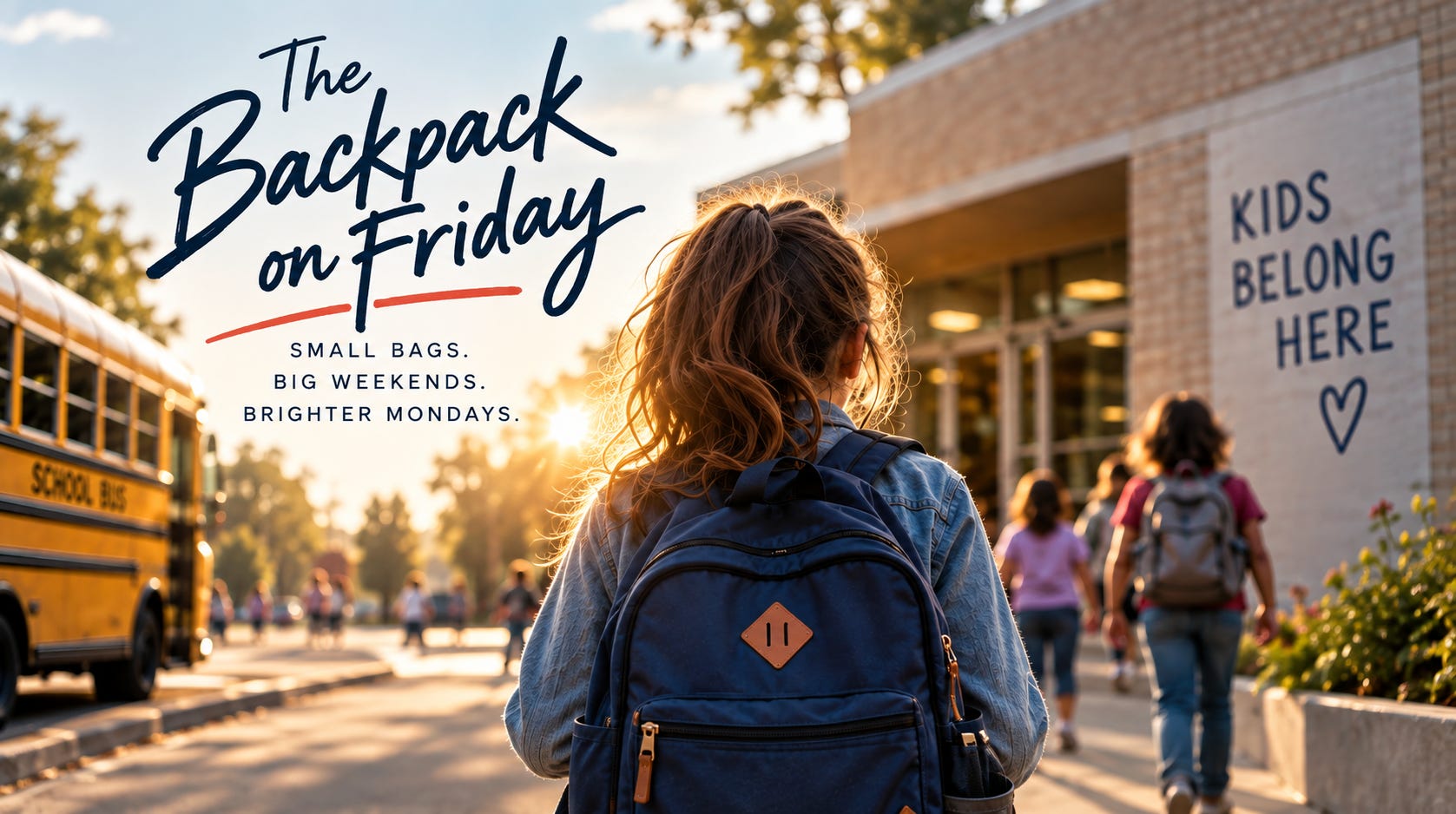
Remember the first stop on the tour? The folding tables behind the community center, the assembly line, the jar of peanut butter (Find it here). Good. Today we’re going inside. And you’ll notice I told you to bring your kids to this one. I meant it. Hold that thought.
This is the second door, and from the sidewalk it’s the easiest one on the whole tour to misread. It looks like a food drive. Cans in a barrel, bags on a table, snacks for kids who need them. Nice. Small. You’ve seen that movie too.
But the people at those folding tables aren’t running a food drive. They’re running a bridge. And to see what the bridge crosses, you have to look at a child’s week the way they do; not as seven days, but as a schedule with a hole in it.
The hole in the week
For a child in a house where the cupboards run thin, the steadiest kitchen in their week is very often the school cafeteria. Breakfast, Monday through Friday. Lunch, Monday through Friday. Whatever else is uncertain in that child’s life, the cafeteria is not. It opens on time, it serves every day, and nobody has to figure out how to pay for Tuesday.
Now watch what happens on Friday.
The lunch bell rings around noon. The trays get stacked. And the next meal that structure provides is Monday breakfast. Count that gap in hours, not meals: from Friday’s lunch line to Monday’s breakfast line is the better part of three days. If the cupboards at home can’t cover it, nothing else automatically does. No bell rings on Saturday.
I told you on the tour: there is no off-switch on a child’s hard life, and institutions have operating hours. The cafeteria is a wonderful institution. It closes Friday afternoon.
So here’s the aha of this whole article, and I’ll drag you back to it the way I dragged you back to the casserole last time: weekend hunger isn’t a shortage problem. It’s a coverage problem. The meals exist Monday through Friday. The hole is Saturday and Sunday, and it’s the same hole, the same hours, in every school in America. Which means — and this is rare, so savor it — it’s a problem you can actually draw on a calendar. And a problem you can draw, you can cover.
That’s what the backpack table is. Not snacks. Coverage.
And let me say the both/and part plainly, because this series doesn’t play one part of the safety net against another. The school meal programs do exactly what they’re built to do, on school days. Food banks and pantries feed whole households. Food assistance helps fill the cart. The backpack team isn’t a substitute for any of it, and they’d be the first to tell you so. The programs cover the school days. The neighbors cover the gap. Not competing roles. A week has seven days; it takes all of it.
What’s actually in the bag
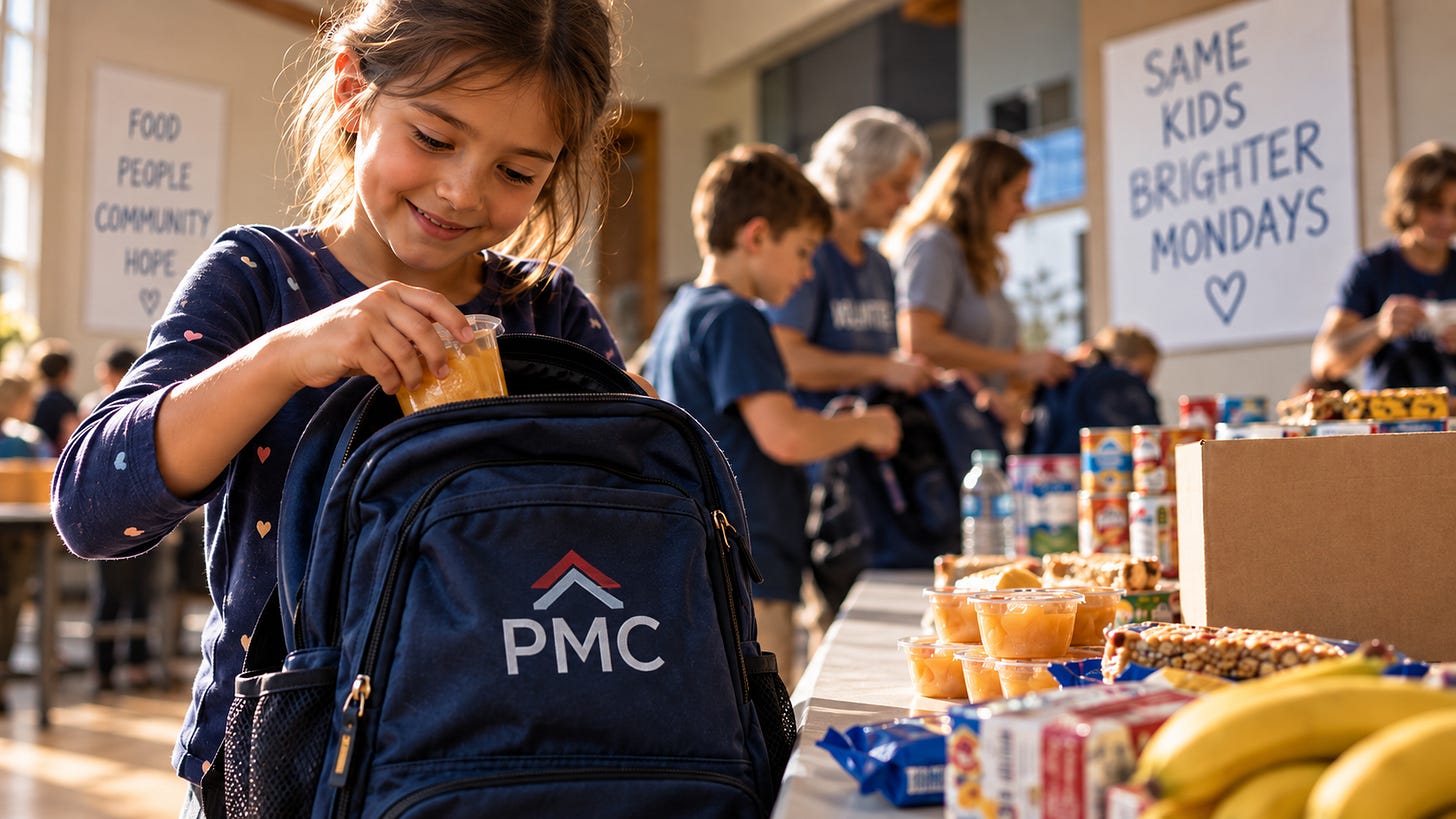
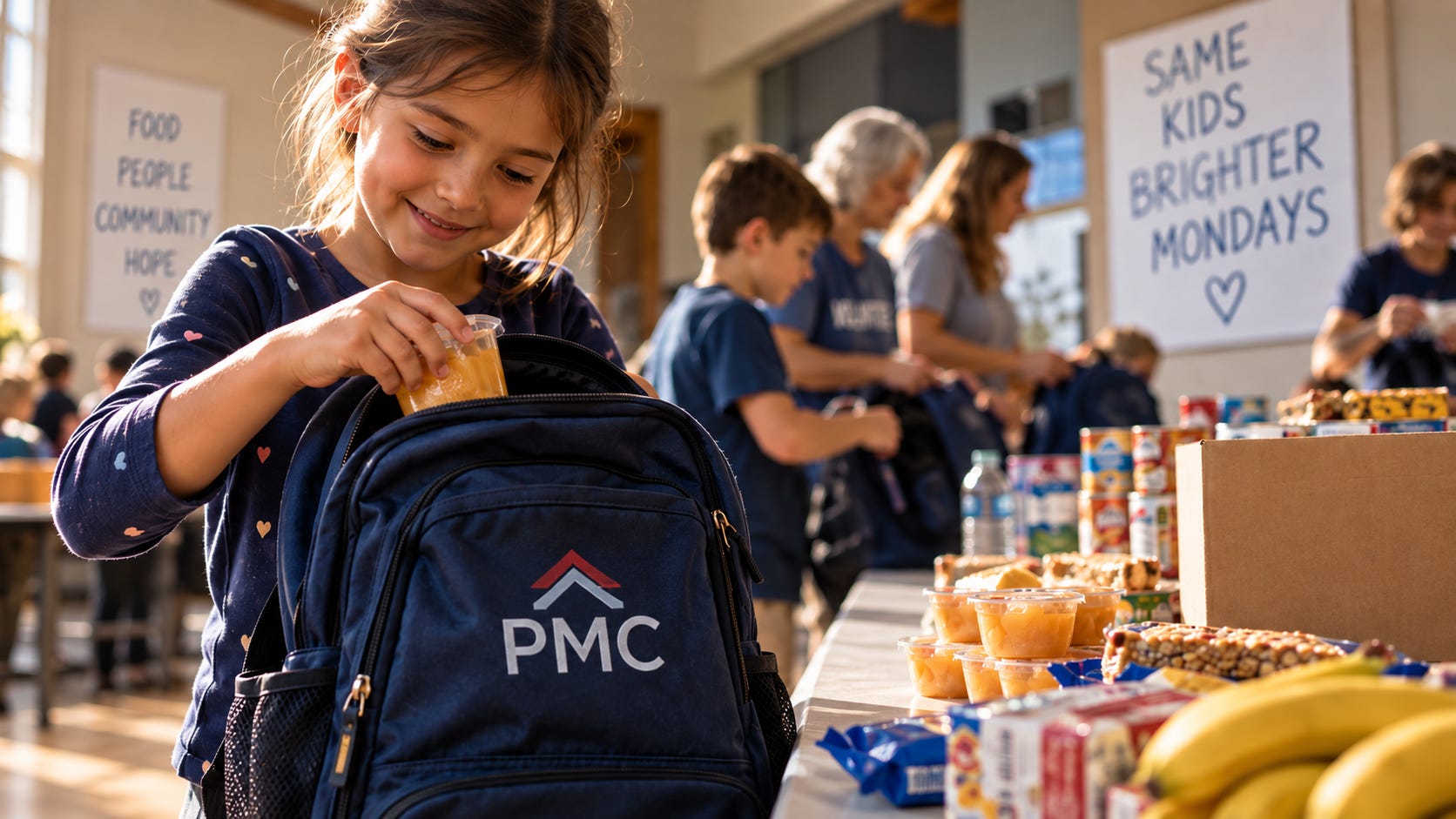
Walk the assembly line with me, because every item on this table was chosen by someone thinking hard about a kitchen you and I hope no child is standing in alone.
Nothing that needs a stove. Nothing that needs a can opener, but instead pop-tops or pouches. Shelf-stable milk, because the refrigerator can’t be assumed. Single servings, because a full-size jar invites a fight over rationing it. Oatmeal packets, fruit cups, crackers, peanut butter; and in a lot of programs, a little extra tucked in, because the kid carrying the backpack sometimes has a younger sibling at home who isn’t in school yet.
Every item answers the same quiet question: can a nine-year-old make this, by herself, for herself and maybe for a four-year-old? Because some weekends, she’s the one making dinner. Not every weekend, not every house. But the bag is packed for the weekend where it’s true.
Read that list again and you’ll notice the bag is a portrait. Somebody sat down and pictured the hardest version of Saturday and packed for that. That’s not charity’s usual arm’s length. That’s the same thing we found in the care community last week, wearing different clothes: neighbors doing the unglamorous engineering of one specific gap.
How the bag moves, and why you’ll never know who got it
Now the part of the machine I most want you to see, because it’s the part built entirely out of dignity.
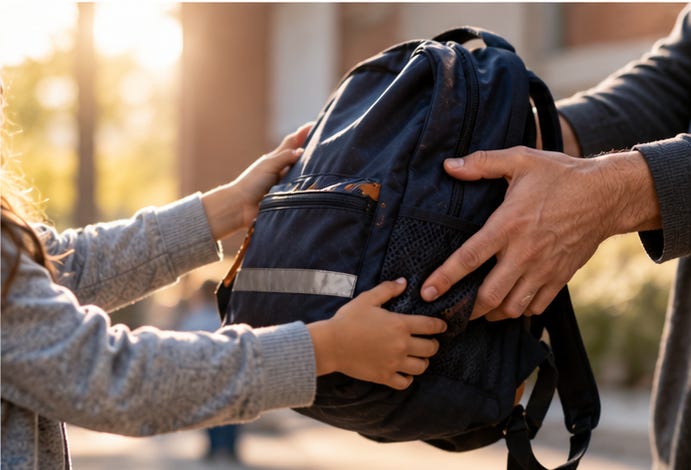
The bags don’t get handed out at a table with a line. There is no line. There is no announcement, no assembly, no moment where a child stands up in front of their class and is identified as the poor kid. The bags slip quietly into backpacks, a counselor’s office, a locker, the last few minutes of Friday when the classroom empties. Different schools do the handoff differently, but the design goal never changes: the child is never singled out. A kid who’s already carrying enough should not also have to carry a label.
Which means the school has to be in it. A teacher notices the Monday stomachaches, the kid who’s first in the breakfast line and last to leave lunch. A counselor keeps the list, and the list is guarded. The volunteers who pack the bags never learn the names, and here’s the thing I need you to sit with, because it’s the same discipline we hit last week: that’s not a flaw in the system. That is the system. You pack for a kid you will never meet, whose name you will never know, and the not-knowing is exactly what protects them. If you need to see the face of the child you helped, this stop isn’t for you. If you can pack a bag for a stranger’s hardest Saturday and let that be enough, welcome to the table.
And the cadence matters as much as the contents. One bag, once, is a kind gesture that’s gone by Sunday. A bag every Friday is something else entirely. It’s a fact about the week. A child who knows the bag comes on Friday has one fewer thing to dread on Thursday night. Same law we found last week, and it governs this whole series: reliability is what turns a kind gesture into infrastructure.
What Monday looks like without the bag
Here’s why this stop matters beyond the weekend itself, and I’m going to walk the chain link by link.
A weekend without enough food doesn’t stay in the weekend. A kid who ate thin on Saturday and Sunday walks into Monday behind. Hunger becomes a stomachache. The stomachache becomes the nurse’s office. The nurse’s office becomes a missed lesson. The missed lesson becomes a kid who’s lost the thread by Wednesday, and a kid who’s lost the thread starts acting like it: fidgeting, snapping, shutting down. Now there’s a behavior note in the file, and the note follows the kid, and nobody wrote hungry anywhere on it.
Ask people who teach in schools where the cupboards run thin, and that Monday pattern comes up again and again. The bag doesn’t fix a family’s finances. It breaks that one chain, at its first link, for the price of a sack of groceries a nine-year-old can manage alone.
And one more thing rides home in the bag, quieter than the food. The bag means an adult at that school noticed. We said it last week and it holds at this stop too: the thing that changes outcomes for kids, the answer that comes up again and again from the people who do this work, is a consistent adult who shows up. The bag is one of the shapes that showing up takes. It says, every Friday, in shelf-stable form: somebody knows your week has a hole in it, and somebody’s covering it.
Where this lives in your town
You’ll find backpack programs running out of food banks, churches, community centers, and school family-resource offices. Several national networks exist to help start and supply them; types, not names, same as always. This series works in every county and I don’t play favorites. But the machine itself is almost embarrassingly simple: a supply of the right food, a crew to pack it, and a school willing to do the quiet handoff. That’s the whole factory. Some of the best ones started as a congregation and a counselor who compared notes.
Which brings me back to your kids, because I promised.
This is the one stop on the whole tour where a seven-year-old is genuinely useful. Packing day is real work a child can do with their own hands. Count the fruit cups, line up the oatmeal, load the bags. And somewhere in that hour, your kid is going to do the math: this bag is for a kid like me, whose weekend doesn’t look like mine. You will not find a better civics lesson for sale anywhere, and this one costs an hour and a case of peanut butter.
Your on-ramps
The humble jar, made reliable. A case of peanut butter, or oatmeal packets, or shelf-stable milk, delivered the same week every month. Put it on your calendar like a bill. Programs plan around what they can count on, so a donor on a schedule isn’t just giving food; they’re giving the program a number it can build with. Small and reliable beats big and occasional. That’s the whole series in six words.
One hour on packing day. Bring your kids. Call whoever runs the program and ask when they pack. Kids are welcome at nearly every table like this. Packing is exactly the kind of work small hands do well.
Ask at the school. Call the counselor’s office: “Does our school send food home with kids on weekends?” If yes, ask what runs out first, you will not stump them; they know their shortfall to the bag. If no, ask whether a nearby school does, because the counselor will know. Either way, you’ve just found the door…or the vacancy.
Fund the expensive shelf. Here’s an unglamorous truth from the packing table: donation barrels fill up with pasta and canned corn, and the items a kid can actually manage alone: shelf-stable milk, protein, pop-top anything, mostly have to be bought. A small monthly gift, marked for the program, buys exactly the things the barrel never produces. Ask the program what they purchase; fund that.
If there’s no program at all…you found the vacancy, not the dead end. The recipe is sitting in this article: a food bank for supply, a congregation or club for hands, a school counselor for the quiet handoff. Ask a nearby town’s program how they started. You don’t have to build it alone. The question is the seed. It always has been.
And when the phone gets heavy, here’s this week’s script:
“Hi! I live here in town. Does our school send food home with kids on the weekend? I’m not looking to start anything big. I’ve got [a case of peanut butter a month / an hour on packing day, and I’d bring my kids / a small monthly donation for the items you have to buy]. What runs out first?”
Next, Stop 3…The Qualifying Room. Read it here!
projectmilkcarton.org • facebook.com/ProjectMilkCarton • X @P_MilkCarton
If you enjoyed this work and feel encouraged by transparency like this, please consider becoming a paid subscriber to Project Milk Carton here on Substack, or donate at Project Milk Carton Inc.
Your support helps us turn information into action for children and families by:
keeping high-risk and missing children visible
identifying gaps in the systems responsible for protecting them
giving families and communities clear, usable information they can act on
supporting education, outreach, and practical community-based solutions
maintaining the public-data and open source work that makes this accountability possible
building tools and resources designed to help communities protect children before they disappear into a system
Most importantly, please share this article.
Transparency survives when ordinary people help spread information.
Informed communities protect children.
ALL paid subscriptions are 100% tax-deductible.
Project Milk Carton | 501(c)(3) | EIN: 33-1323547