

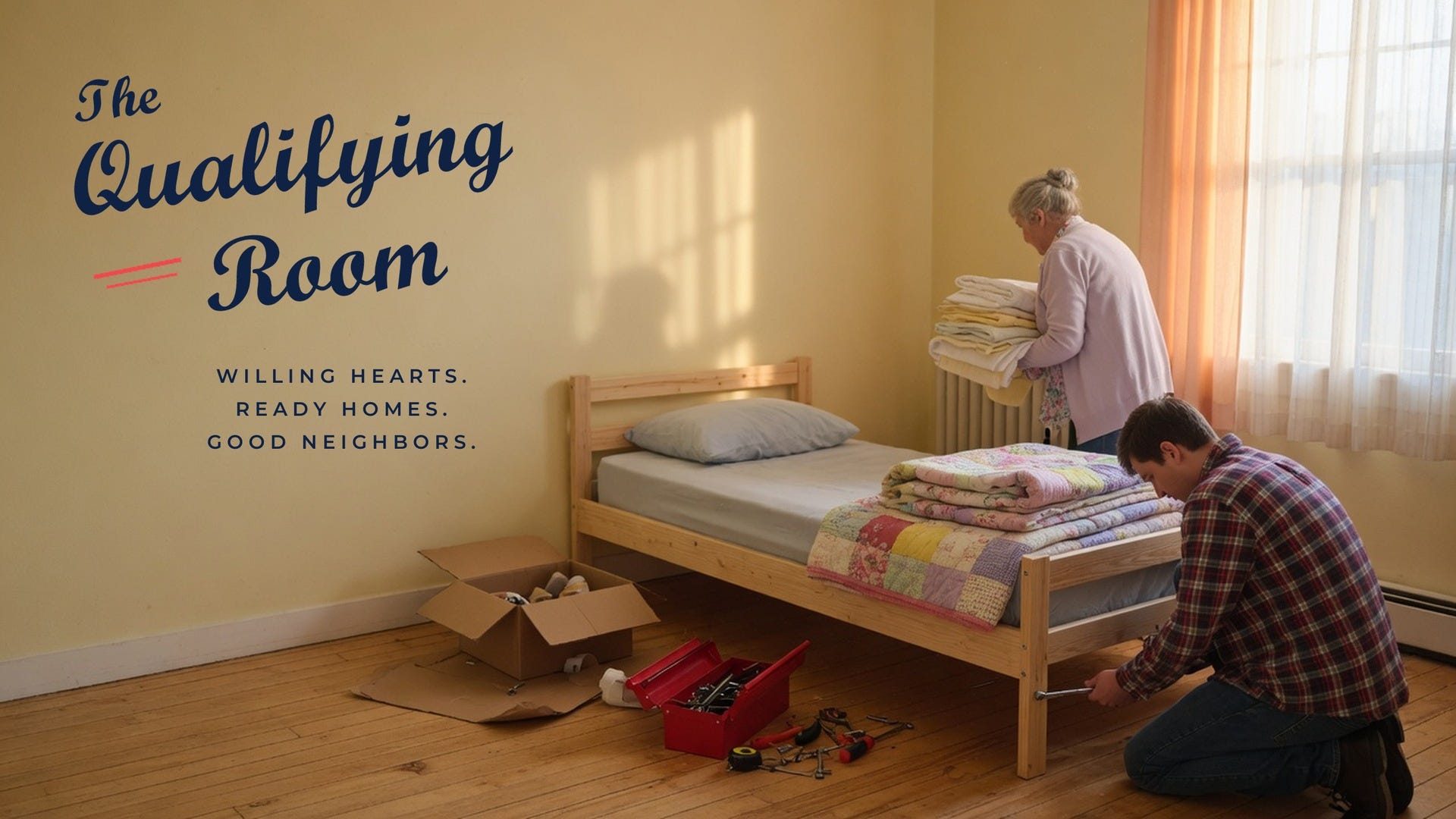
Remember the last stop on the tour? The folding tables, the packing line, the bags that slip quietly into backpacks on Friday (Find it here). Good. Today we’re walking into a room most people have never heard of.
There’s a child who needs somewhere safe to live. And there’s an adult saying, “I’ll take them.”
You would think those two facts would fit together pretty neatly. Sometimes they do. But when a child is entering foster care or going to live with relatives, saying yes can be the beginning of the process, not the end of it.
That’s where we’re stopping today.
Welcome to The Qualifying Room.
When “yes” still has requirements
Let’s start with the obvious. We want children placed in safe homes. That means there should be standards for the adults and homes trusted to care for them.
Foster parents generally go through approval or licensing processes set by their states. Those processes can include background checks, training, home assessments and safety requirements. Kinship caregivers (relatives and close family friends) may follow a different path, depending on the state and the placement. Federal rules let agencies set separate standards for relative and kinship homes.
Those requirements matter.
But here’s what I want you to notice on our tour. Sometimes there is a perfectly willing adult on one side of the process and a child who needs that adult on the other. In between them are practical things that have to get done.
That’s the space we’re visiting today.
Imagine getting the phone call
A grandmother gets a call that her grandchildren cannot safely stay at home.
Maybe addiction has taken over her daughter’s life. Maybe there has been violence in the home. Whatever happened, tonight the question isn’t theoretical anymore. There are children who need somewhere safe to go, and Grandma says yes.
Of course she does.
But loving those children and being ready to suddenly care for them are two different things.
She may need another bed. She may need car seats. There may be safety items required in the home. There may be paperwork, appointments or training to complete, depending on how the placement is being handled.
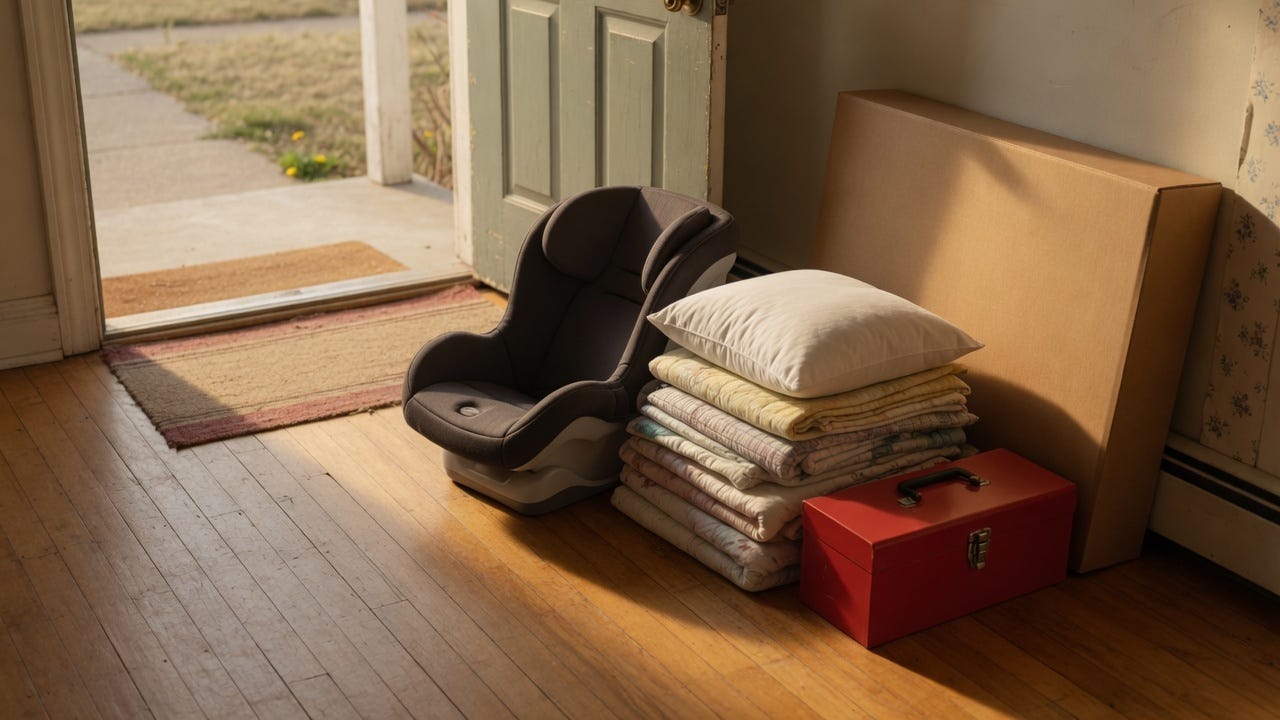
None of that means Grandma is unfit.
It means Grandma wasn’t expecting to become a full-time parent again on Tuesday.
And this is where the rest of us can become truly useful.
Not everything requires a professional
Some parts of foster care and kinship care belong to professionals. Background checks belong to the proper authorities. Home assessments belong to the people trained and authorized to do them. Decisions about whether a child can safely be placed in a home are not ours to make.
But nobody needs a social-work degree to assemble a bed.
That difference is important.
Sometimes people stay away from child welfare because they assume helping means becoming a foster parent, working for an agency or taking on jobs they aren’t qualified to handle.
It doesn’t.
There is a huge amount of ordinary work around the extraordinary moment when a child suddenly needs a safe place to land.
Somebody can deliver the bed. Somebody can assemble it. Somebody can bring over dinner while the adults handle paperwork. Somebody can help get the house ready. Somebody can provide the practical things a caregiver or a trusted local group says are needed.
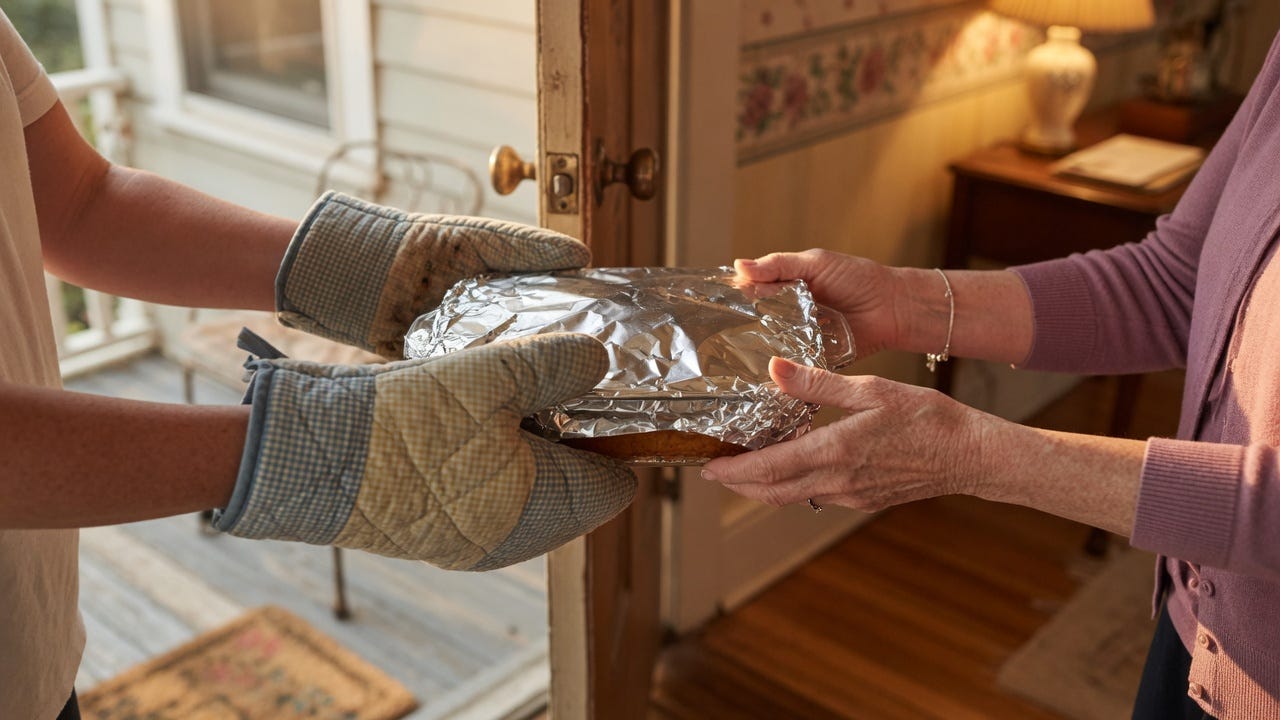
The professionals can do the work that requires professionals.
We can do the work that requires neighbors.
A willing home is worth supporting
I think kinship families are especially important for us to notice here.
When a relative steps forward for a child, that relative isn’t simply offering a spare bedroom. They may be stepping right into the aftermath of something painful inside their own family.
Grandma may be trying to comfort frightened grandchildren while worrying about her daughter. An aunt may suddenly be rearranging work and childcare because her sister is in treatment. Relatives can be grieving, angry, confused and overwhelmed, all while trying to become the steady adults a child needs.
That’s a lot to carry.
So perhaps our first question shouldn’t always be, “What does this family need from the system?”
Sometimes another good question is, “What can the rest of us take off their plate?”
Now we’re back in familiar territory.
Remember Stop One? The circle around one family wasn’t there to fix the family. It was there so the people carrying the heaviest load didn’t have to carry every ordinary load too.
The same idea works here.
Find this room in your town
The Qualifying Room won’t have that name on a door, of course.
Look for the groups in your community already working with foster and kinship families. Your county or state child-welfare agency may be able to point you toward foster-parent associations, kinship-support groups and community partners. Churches and established nonprofits may also have programs built to give practical support to caregivers.
Then ask a very simple question:
“What practical things keep willing foster or kinship caregivers from being ready to receive a child, and what can ordinary community members help with?”
Let them tell you.
That’s important. Don’t decide what they need and arrive with a truckload of whatever sounded useful on the internet. The people doing this work locally know where the gaps are, and the rules are different from place to place.
Perhaps there’s already a program in your town that sets up bedrooms for children entering care. Maybe volunteers help with approved household needs. Maybe what they need most is a dependable group of people they can call when a caregiver suddenly has children arriving.
Find the people who already know the process before trying to invent another one.
The point of this stop
We started this tour because I wanted you to see something about child welfare that is easy to miss from the outside.
When we hear that a child has been removed from an unsafe home, we tend to picture the system taking over from there.
But “the system” doesn’t tuck a child into bed that night.
A person does.
Somewhere there is a foster parent, grandmother, uncle, aunt or other caregiver opening a door and making room in a life that may have looked completely different yesterday.
There are professionals whose job is to decide whether that door is safe for a child to walk through.
But once they’ve done their part, there is plenty of room for a community to stand behind the person who opened it.
That’s what I wanted you to see in The Qualifying Room.
Not another program to fund. Not another system to build. Just one more place in our town where ordinary people can make themselves useful.
And sometimes useful looks remarkably ordinary.
It looks like putting together the bed before the child gets there.
Your steps for this week
Search online for your county or state child-welfare agency. Call the main number or use the contact page.
Ask: “Which local groups help foster and kinship families get a home ready for a child?”
Call one of those groups. Ask: “What practical things do caregivers need, and what can a neighbor like me help with?”
Pick one job they name and do it. Build the bed. Bring the dinner. Give the ride.
Share this article with one person who would help you.
If you are worried a child is being hurt or neglected, call or text Childhelp at 1-800-422-4453, any time. If a child is in danger right now, call 911.
Coach Mel
New to the series? Start at the first stop: Let Me Take You on a Tour.
Stop 1 in the series is here. Stop 2 in the series is here.
Want to wear the mission?
projectmilkcarton.org • facebook.com/ProjectMilkCarton • X @P_MilkCarton
If you enjoyed this work and feel encouraged by transparency like this, please consider becoming a paid subscriber to Project Milk Carton here on Substack, or donate at Project Milk Carton Inc.
Your support helps us turn information into action for children and families by:
keeping high-risk and missing children visible
identifying gaps in the systems responsible for protecting them
giving families and communities clear, usable information they can act on
supporting education, outreach, and practical community-based solutions
maintaining the public-data and open source work that makes this accountability possible
building tools and resources designed to help communities protect children before they disappear into a system
Most importantly, please share this article.
Transparency survives when ordinary people help spread information.
Informed communities protect children.
ALL paid subscriptions are 100% tax-deductible.
Project Milk Carton | 501(c)(3) | EIN: 33-1323547