

This is the final part of a five-part series. Part 1 covered the law that was supposed to end child warehousing. Part 2 followed the money. Part 3 covered what happens to children inside these facilities. Part 4 asked who was supposed to be watching. Part 5 asks why reform keeps failing, what real accountability would require, and the one question nobody in this system wants to answer. The complete version of this report is available as the exhaustive report.
Why Reform Keeps Failing
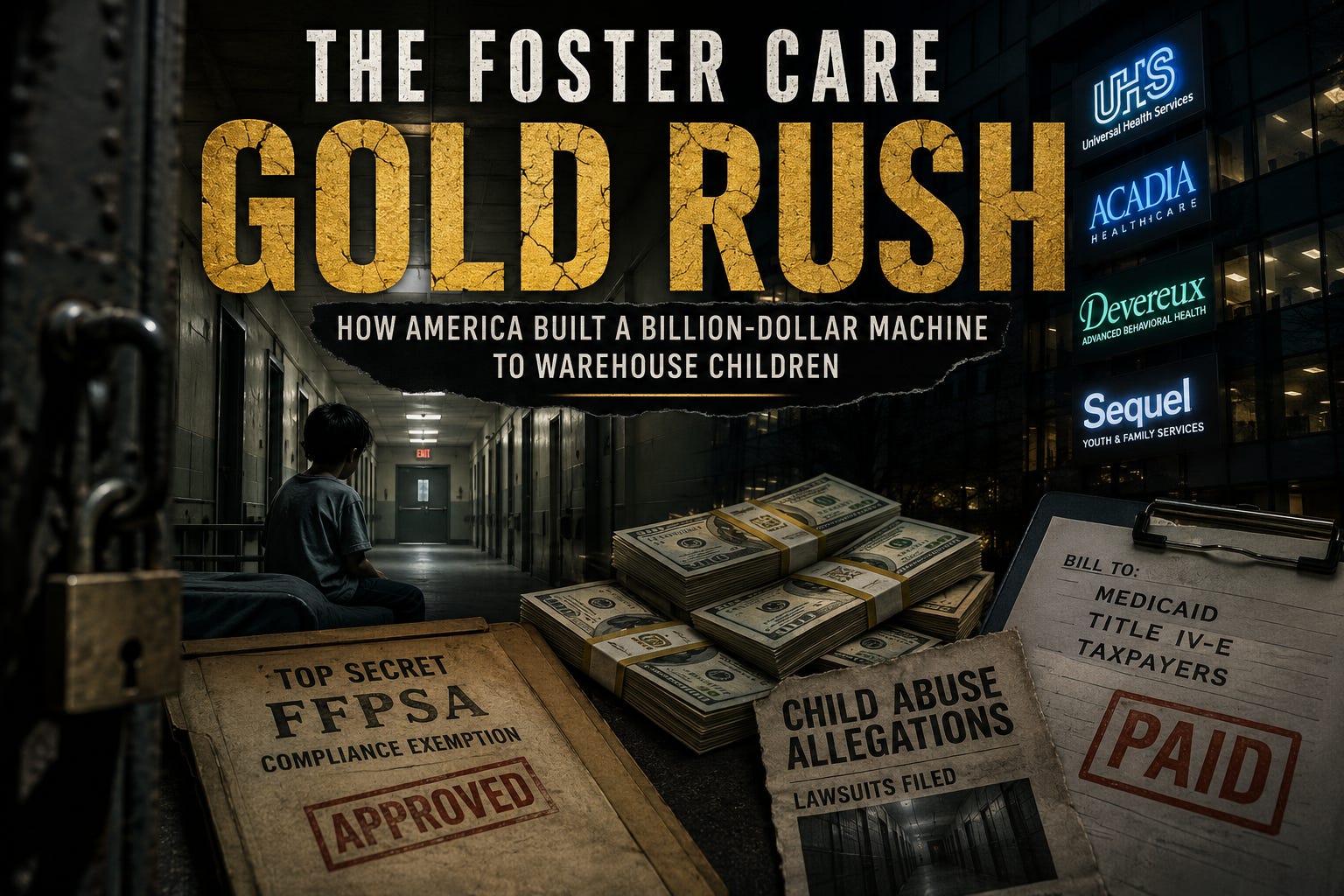
Child welfare reform fails when it changes rules without changing incentives. FFPSA restricted reimbursement and promoted prevention, but it did not eliminate the placement crisis. It did not create enough therapeutic foster homes overnight. It did not solve workforce shortages. It did not rebuild community mental health systems. It did not provide enough intensive wraparound care to prevent institutionalization for every high-need child. It did not break the dependence states had already developed on residential providers.
Every actor in the system faces pressure. Caseworkers need immediate placements. Judges need viable options. State agencies need contractors willing to accept difficult cases. Facilities need occupancy. Medicaid systems process claims. Legislators want reform without owning the cost of building alternatives. Families in crisis need support long before removal, but prevention systems remain uneven. In that environment, congregate care survives because it offers a crude solution to immediate system failure: a bed.
That bed may be expensive, harmful, distant, and poorly monitored. But it exists. For an agency facing a child with acute behavioral needs and no foster family available, existence can outweigh quality. This is the moral hazard at the center of the system. Once a facility network exists, governments use it because they need it. Once governments use it, operators remain financially viable. Once operators remain viable, they lobby, expand, rebrand, and embed themselves further into the system.
Scandal alone does not end the model because scandal can be localized. A facility closes. A company changes its name. A settlement is paid. A few staff are fired. A state announces new monitoring. But the placement need remains, and another facility steps in. Unless the underlying demand is reduced through real family preservation and community care, the system keeps reproducing itself.
The public also struggles to follow the complexity. Title IV-E, QRTP, PRTF, Medicaid, IMD, ACF, CMS, NCANDS, AFCARS, CARF, Joint Commission: the alphabet soup protects the system from scrutiny. Ordinary readers understand that children should not be abused in facilities, but the financial mechanisms that keep those facilities operating are buried inside bureaucratic language. That complexity is not accidental in its effect. It makes outrage harder to sustain and accountability harder to assign.
The reform failure is therefore not a mystery. America tried to reduce institutional care without fully replacing the institutional function. It tried to restrict funding without closing alternate billing channels. It tried to enforce standards through systems already dependent on provider capacity. It asked courts to review placements without ensuring judges had independent information. It asked states to self-report compliance while states faced financial and operational pressure to preserve congregate care options. The result was predictable: adaptation, not transformation.
The Question America Refuses to Ask
At the center of this investigation is a question policymakers rarely say out loud: What if the institutional foster care model is not malfunctioning, but functioning according to its incentives? If revenue depends on occupied beds, then empty beds become financial problems. If staffing is the largest controllable cost, then understaffing becomes tempting. If Medicaid pays for treatment intensity, then high-acuity classifications become financially useful. If accreditation unlocks reimbursement, then certification becomes a business necessity. If states lack alternatives, then even troubled facilities remain indispensable.
Once billions of public dollars flow through a system, constituencies form around that money. Facility operators, lead agencies, subcontractors, consultants, accreditors, managed care organizations, pharmaceutical companies, legal vendors, lobbyists, and state bureaucracies all become part of the ecosystem. Not every actor is malicious. Many people inside the system genuinely want to help children. But good intentions do not erase structural incentives. A system can be filled with well-meaning individuals and still produce institutional harm because the financial architecture rewards the wrong outcomes.
FFPSA attempted to push the system away from warehousing by limiting federal reimbursement. The system responded through reclassification, QRTP certification, child-specific exceptions, trafficking exemptions, Medicaid billing, state funding substitution, out-of-state placements, and corporate restructuring. That response reveals the resilience of the institutional model. The machine did not need to publicly oppose reform. It only needed to metabolize reform into new administrative routines.
This is why dismantling child warehousing requires more than new terminology. It requires attacking the economic structure beneath the terminology. If states are paid or pressured in ways that make institutional beds necessary, beds will remain. If Medicaid continues paying massive sums without integrated child welfare oversight, operators will continue building treatment capacity around billable children. If courts approve placements based on agency paperwork rather than independent evidence, judicial review will remain procedural. If accreditors certify facilities without transparent public accountability, certification will remain insufficient.
The moral clarity is not complicated. Children should not be placed in institutions because governments failed to build families, services, and communities capable of supporting them. Children should not be medicated into manageability because facilities lack staffing. Children should not be shipped across state lines because local systems collapsed. Children should not be sexually abused in facilities funded by taxpayers. Children should not die in restraints administered by adults paid to protect them.
The complexity lies in dismantling the machine that makes these outcomes recurring rather than exceptional.
The Children Behind the Statistics
Large investigations can become abstract. Revenue figures, federal audits, state surveys, legal citations, and settlement amounts are necessary, but they can also distance readers from the central reality. Behind every metric is a child whose life was interrupted by systems claiming to act in their best interest. A child removed from home. A child placed in a facility far away. A child told the placement was temporary. A child who stayed for months. A child who learned that adults with clipboards, badges, policies, and treatment plans could still fail to protect them.
Institutional language hides pain. “Placement disruption” may mean a child lost another home. “Behavioral incident” may mean a traumatized teenager panicked. “Physical intervention” may mean adults held a child down. “Medication adjustment” may mean sedation. “Out-of-state placement” may mean separation from siblings and everyone familiar. “Length of stay” may mean a childhood measured in billing days. “Level of care” may mean a locked door.
This language matters because systems use it to make the intolerable sound administrative. The public hears technical terms and assumes professionals are managing complexity. Sometimes they are. But sometimes technical language becomes a fog machine, obscuring the simple moral fact that children are being confined in harmful environments because adults built a system that needs somewhere to put them.
The research brief’s fatality data adds a grim backdrop. National child welfare fatalities rose from 1,825 in 2019 to 1,968 in 2023, with a peak of 2,010 in 2022. Not all of those deaths occurred in congregate care, and no responsible investigator should claim they did. But the broader trend matters because it shows a child welfare system under severe stress at the same time it claims to be reforming. A system that cannot prevent rising fatalities, cannot reliably track maltreatment in residential settings, and cannot reduce institutional placement should not be trusted on paperwork alone.
The children most likely to be institutionalized are often those with the least public sympathy: teenagers, children with behavioral diagnoses, children with trauma histories, children who have run away, children labeled aggressive, children who have already experienced multiple failed placements. That is precisely why they need stronger protection, not weaker. Systems can justify almost anything once a child is labeled difficult. The label becomes a permission structure. The child becomes a problem to manage rather than a person to defend.
If America is serious about child welfare, it must stop judging systems by the elegance of their policy language and start judging them by what happens to the children with the least power inside them. Not the children featured in brochures. Not the pilot-program success stories. The teenager restrained in a facility. The girl reporting abuse by staff. The boy waking up in an office because no placement exists. The youth taking four medications. The child sent three states away because the local system ran out of options.
That is where the truth of the system lives.
What Real Accountability Would Require
Real accountability would begin with data integration. CMS and ACF should be required to cross-reference Medicaid claims with child welfare placement records so federal officials can see the total taxpayer cost per child, per facility, per operator, and per episode of care. Without integrated data, the system cannot identify dual-billing patterns, unusually long stays, repeated admissions, questionable medical necessity, or facilities that generate high revenue while producing poor outcomes. The current fragmentation benefits everyone except the child.
Second, QRTP certification should be audited independently at the facility level. Not through paper reviews, but through outcome-based investigations. Auditors should examine restraint rates, seclusion use, psychotropic prescribing patterns, staff turnover, abuse allegations, law enforcement calls, hospitalization rates, family contact, discharge stability, reentry into congregate care, educational progress, and youth interviews. A facility should not keep QRTP status merely because its policy manual uses the right language.
Third, child-specific exceptions and trafficking-related exemptions should be tracked nationally and published in usable form. If a state relies heavily on exceptions, that is not a footnote; it is a warning signal. Federal agencies should examine whether exceptions are clustered by facility, region, diagnosis, age group, race, disability, or court. They should also test whether community alternatives were genuinely unavailable or simply underdeveloped.
Fourth, out-of-state placements should trigger heightened scrutiny. Every child placed across state lines should generate automatic reporting to the sending court, receiving state regulator, federal oversight entities, and the child’s attorney or advocate. States should have to justify why no in-state family or community-based option exists, how family contact will be preserved, how education will continue, and how abuse reports will be monitored.
Fifth, psychotropic medication oversight must become real rather than symbolic. Children in state custody receiving multiple psychiatric medications should have independent medication review, especially when they are placed in congregate care. Prescribing patterns should be analyzed by facility and operator. If one facility has unusually high rates of polypharmacy, that should trigger investigation. Medication should never become a staffing substitute.
Sixth, civil rights enforcement must move from theory to action. DOJ and HHS should examine whether states are violating the Olmstead integration mandate by unnecessarily institutionalizing foster youth with mental health disabilities. If children could be served in family or community settings with appropriate supports, then failure to build those supports should not be accepted as an excuse for segregation. The ADA does not disappear when a child enters foster care.
Finally, financial accountability must follow corporate structures. Investigators should track parent companies, private equity ownership, successor entities, facility sales, management agreements, and rebrands. A facility network with a history of abuse should not be able to escape scrutiny by changing names. States should be required to disclose whether providers or related entities have histories of settlements, verdicts, license actions, deaths, or substantiated abuse.
These reforms are not radical. They are the minimum requirements for a system that claims the legal right to remove children from their families and place them under state-approved control. If the state takes custody of a child, the state assumes a duty higher than paperwork compliance. It assumes the duty to protect.
The Reckoning Ahead
The foster care system is approaching a collision point. Lawsuits are growing. Federal investigations are sharpening. Former foster youth are speaking publicly. Journalists are beginning to connect residential treatment scandals to Medicaid billing, corporate ownership, and FFPSA loopholes. The old defense, that these are isolated incidents in otherwise necessary facilities, is becoming harder to sustain.
America now faces two possible futures. The first is cosmetic reform. Facilities will rebrand. Operators will update websites. States will revise guidance. Accrediting bodies will adjust standards. Agencies will promise stronger monitoring. Congress will hold hearings. A few facilities may close. A few settlements may be paid. But the underlying placement economy will remain intact, and children will continue cycling through institutional pipelines under new names.
The second future is more difficult. It requires admitting that child warehousing is not only a policy failure but an economic structure. It requires building enough community-based care that states no longer depend on residential beds as the default emergency solution. It requires funding family preservation before removal, therapeutic foster care before institutionalization, and aftercare before discharge failure. It requires treating congregate placement as a system failure to be explained, not a routine option to be processed.
The Family First Prevention Services Act was supposed to mark the beginning of the end for institutional foster care. Instead, it revealed how deeply institutional care was embedded in the child welfare economy. The law exposed an uncomfortable truth: a system built over decades cannot be dismantled by changing reimbursement language alone. The warehouses did not close because too many agencies, operators, and funding streams still depended on them.
Somewhere tonight, a child is entering one of those facilities. Their file will contain professional language. Their placement will have a justification. Their care may be billed through Medicaid. Their room and board may be tied to state or federal funds. Their facility may be accredited. Their treatment plan may say trauma-informed. Their court order may say necessary. Every document may appear orderly.
But the deeper question remains unanswered: did that child need an institution, or did the institution need that child?
Until America is willing to answer that question honestly, the foster care gold rush will continue under the banner of reform. The children will keep moving through the machine. The beds will stay full. The invoices will be paid. And the country will keep pretending that a warehouse becomes a treatment program simply because the sign on the door changed.
What You Can Do
This is the last part of the series, so this list is the one to keep. Every item is lawful, public, and available to an ordinary person with an email account.
Pick one question and actually ask it. The single most useful thing a reader can do is email their state child welfare agency’s public information office and ask one specific question: how many children are in congregate care, how many are placed out of state, how many facilities are certified as QRTPs, or how the six-month aftercare requirement is met. One question, politely asked, gets answered far more often than a long list.
Follow the money in your own state. Licensed facility lists, per diem rates, and provider contracts are public. Nonprofit operators file a Form 990 every year, and Schedule I shows who received money. Publicly traded operators describe their own litigation in the “Legal Proceedings” section of their annual 10-K filings.
Track the federal recommendations that are already on the books. GAO has recommended that HHS clarify its guidance on the trafficking exemption. The HHS inspector general has recommended that ACF help states track maltreatment patterns across facilities and corporate chains. Both recommendations are public and their status is trackable. An agency that has not acted in two years is a story.
Watch for the National Academies study. The Stop Institutional Child Abuse Act, signed into law in December 2024, requires the Department of Health and Human Services to contract with the National Academies of Sciences, Engineering, and Medicine to study abuse, neglect, and deaths in youth residential programs, with reports required over the following decade. It is the closest thing to a national accounting that currently exists.
Support the people already inside the fight. Your state’s federally funded Protection and Advocacy agency can enter facilities and look into abuse of children with disabilities. Foster youth advocacy organizations, legal aid groups, and CASA programs all take volunteers. Serving on a citizen review board puts an ordinary person in the room where placements are reviewed.
Write to the people who control the budget. State legislators write child welfare appropriations. A short, factual email that names a federal finding and asks what your state is doing about it carries more weight than a petition with a thousand signatures.
If a child is in immediate danger, call 911. To report a missing child or a tip about one, contact law enforcement or the National Center for Missing & Exploited Children at 1-800-THE-LOST (1-800-843-5678). Suspected abuse or neglect of a child in care can be reported to your state’s child abuse hotline and to the state office that licenses residential facilities.
projectmilkcarton.org • t.me/ProjectMilkCarton • X @P_MilkCarton
If you enjoyed this work and feel encouraged by transparency like this, please consider becoming a paid subscriber to Project Milk Carton here
Donate at Project Milk Carton Inc. or at https://t.co/PvtnrODkNz
Your support helps us turn information into action for children and families by:
keeping high-risk and missing children visible
identifying gaps in the systems responsible for protecting them
giving families and communities clear, usable information they can act on
supporting education, outreach, and practical community-based solutions
maintaining the public-data and open source work that makes this accountability possible
building tools and resources designed to help communities protect children before they disappear into a system
Most importantly, please share this article.
Transparency survives when ordinary people help spread information.
Informed communities protect children.
ALL paid subscriptions are 100% tax-deductible.
Project Milk Carton | 501(c)(3) | EIN: 33-1323547
SOURCES FOR PART 5
Federal Government Sources:
GAO-26-107592, “Child Welfare: HHS Should Clarify Guidance on State Spending for Congregate Care” (March 3, 2026), gao.gov
HHS OIG, “Many States Lack Information To Monitor Maltreatment in Residential Facilities for Children in Foster Care” (OEI-07-22-00530, June 2024), oig.hhs.gov
U.S. Senate Finance Committee, “Warehouses of Neglect: How Taxpayers Are Funding Systemic Abuse in Youth Residential Treatment Facilities” (June 12, 2024), finance.senate.gov
Stop Institutional Child Abuse Act, P.L. 118-194 (signed December 23, 2024), govinfo.gov
Family First Prevention Services Act, P.L. 115-123, 42 U.S.C. § 672(k)
Olmstead v. L.C., 527 U.S. 581 (1999), and DOJ Statement of Interest in Ocean S., et al. v. Los Angeles County, et al., justice.gov
NCANDS: national child welfare fatalities (2019-2023)
AFCARS: national foster care population trends
Journalism and Analysis:
The Imprint, “Report Finds Family First Act Has Not Reduced Congregate Care in Most States” (March 2026), imprintnews.org
Child Welfare Monitor, “Surprise, surprise! Family First has not reduced the use of congregate care!” (March 2026), childwelfaremonitor.org
The Hill, “Five years on, the Family First act has failed in its aims”
Duke Law, “FFPSA: Expectations, Limitations, and Reality”
https://rumble.com/v7ac5bg-save-the-children.html