

The couch is the same couch. The blanket is the same blanket. Your daughter is curled up where she always sits, giggling at her tablet, building some world out of blocks in a game half the kids in America play. Everything about the picture says safe.
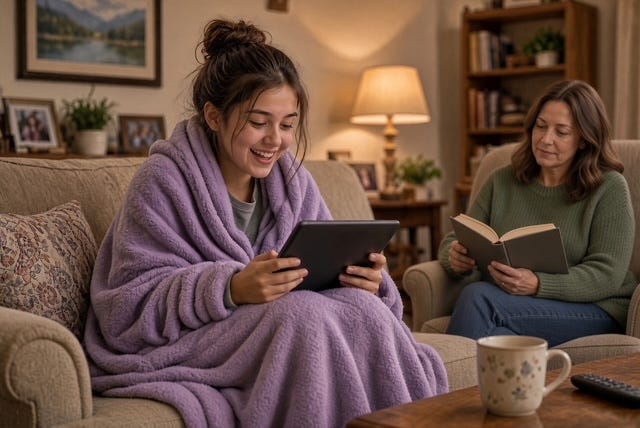
That picture is why this article exists. Because the danger we grew up teaching kids about (the stranger at the park, the car that slows down) has moved. It now arrives through the same screen that shows her cartoons, wearing a friendly avatar and offering a gift. And most of us, parents and grandparents alike, were never taught what that looks like.
So let’s learn it together, calmly. That’s what this is. Not an alarm. A porch-light conversation.
What “764” is, in plain language
764 is the name of a loose online network, named after part of a Texas zip code where it started around 2021. Its members deliberately seek out children on the platforms kids love: games, chat apps, messaging services. They befriend a child, earn trust, and then use threats and blackmail to push that child into things no child should ever be pushed into: sending images, hurting themselves, keeping terrible secrets.
This is not an internet rumor. As of this writing, the FBI has opened cases on more than 350 people connected to 764 and its offshoots, with every FBI field office in the country involved, and bureau officials have called these networks one of the most serious threats facing American kids. Congress opened its own inquiry this year. Canada has gone as far as classifying the network as a terrorist entity, the first country to do so. Agents have said publicly that reports are coming in faster than they can keep up, which is exactly why families can’t wait for someone else to handle it.
And here is the sentence I most need you to sit with: the children they target are not troubled kids from troubled homes. They are ordinary, loved, looked-after kids, some as young as nine, reached in their own living rooms.
One family’s story
Last year, the parents of a 13-year-old boy named Jay chose to tell the country what happened to their son. Jay was groomed online by a member of this network, a grown man an ocean away, who pushed him, message by message, toward taking his own life. Jay died. His mother and father have stood in front of cameras since, reliving the worst thing that will ever happen to them, for one reason: so that the next family would know this exists before it knocks.
His father said something that stays with you: what frightened him most was that these predators reach directly into a child’s mind, past every lock on every door.
We honor families like Jay’s by doing the one thing they asked: knowing.
What it actually looks like
Not scary strangers. That’s the trick of it. It looks like:
A new “friend” in a game who is generous with gifts, compliments, and attention.
A request to move the conversation somewhere more private, like a different app or a DM.
Secrets: “don’t tell your parents,” “this is just between us.”
Small asks that grow: personal questions, then a photo, then worse, with each step used as leverage for the next.
A child who suddenly guards the screen, sleeps badly, drops friends, or seems frightened of their own device.
If you’ve read our series The Stories Our Kids Are Sold, you’ll recognize the pattern: flattery, belonging, secrecy, escalation. Different network, same old ladder. And the same rung breaks it: secrecy. A child who tells is a child these people cannot hold.
The good news (and there is real good news)
Children are being found and helped. Arrests are happening across the country and overseas. Platforms are under public pressure like never before. And in case after case, the story turns on something beautifully ordinary: a parent who asked one more question. A grandmother who noticed the light was off in a kid who’s usually all light. A child who had been told, and believed,
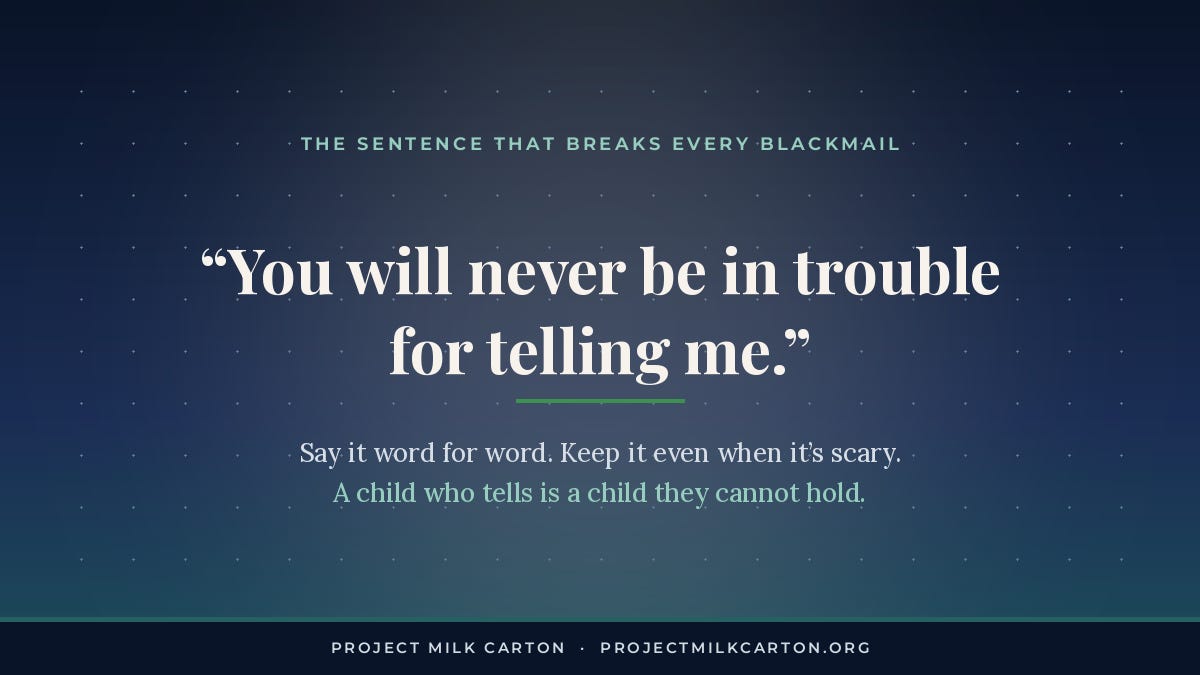
“you will never be in trouble for telling me”. A child who experiences, “my family is standing in front of me, between me and an evil intruder, to shield me from harm.
That’s not a small thing. That is the whole thing. Every layer of this, the FBI cases, the hearings, the headlines, exists to buy time for one conversation at one kitchen table. Yours.
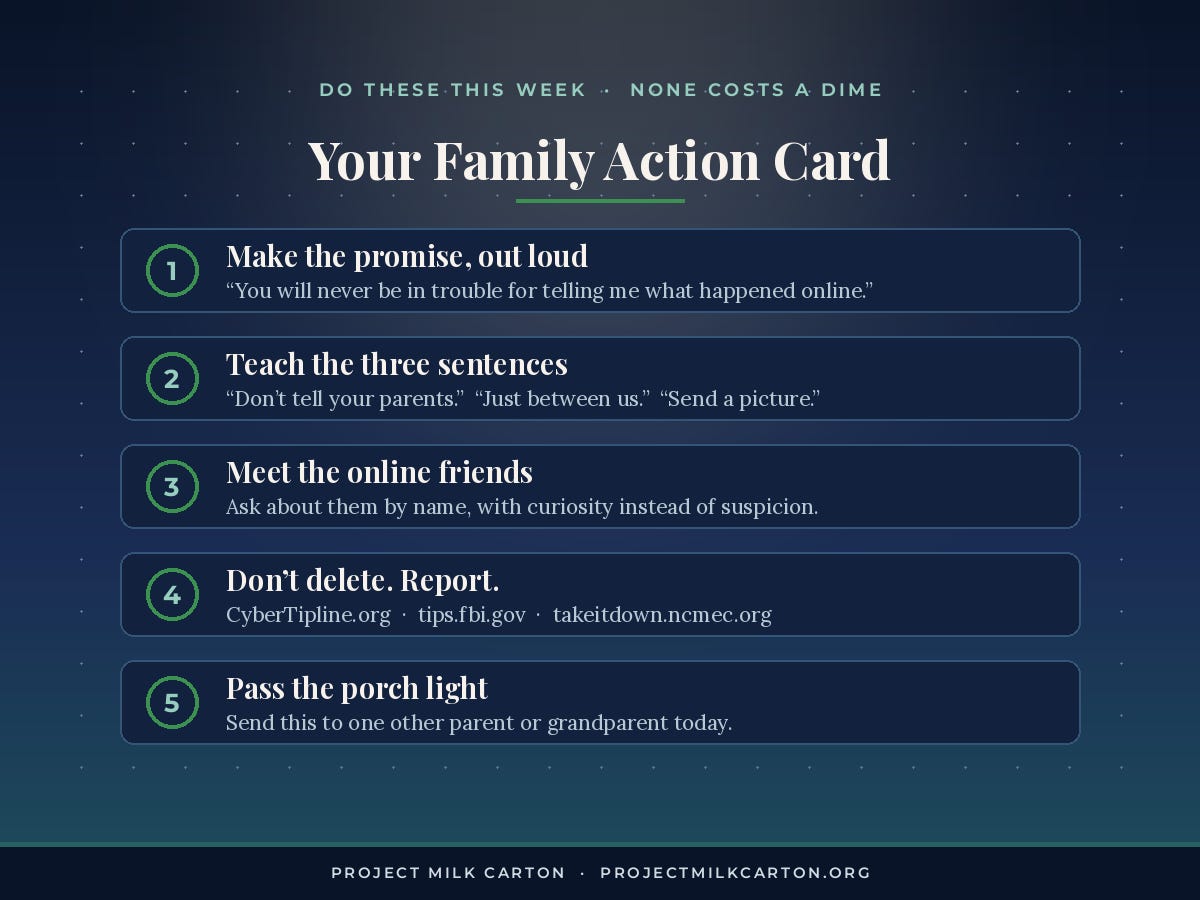
The Action You Can Easily Do
Do these this week. None of them costs a dime.
Make the promise, out loud: “You will never be in trouble for telling me what happened online.” Say it word for word. It removes the only weapon blackmail has.
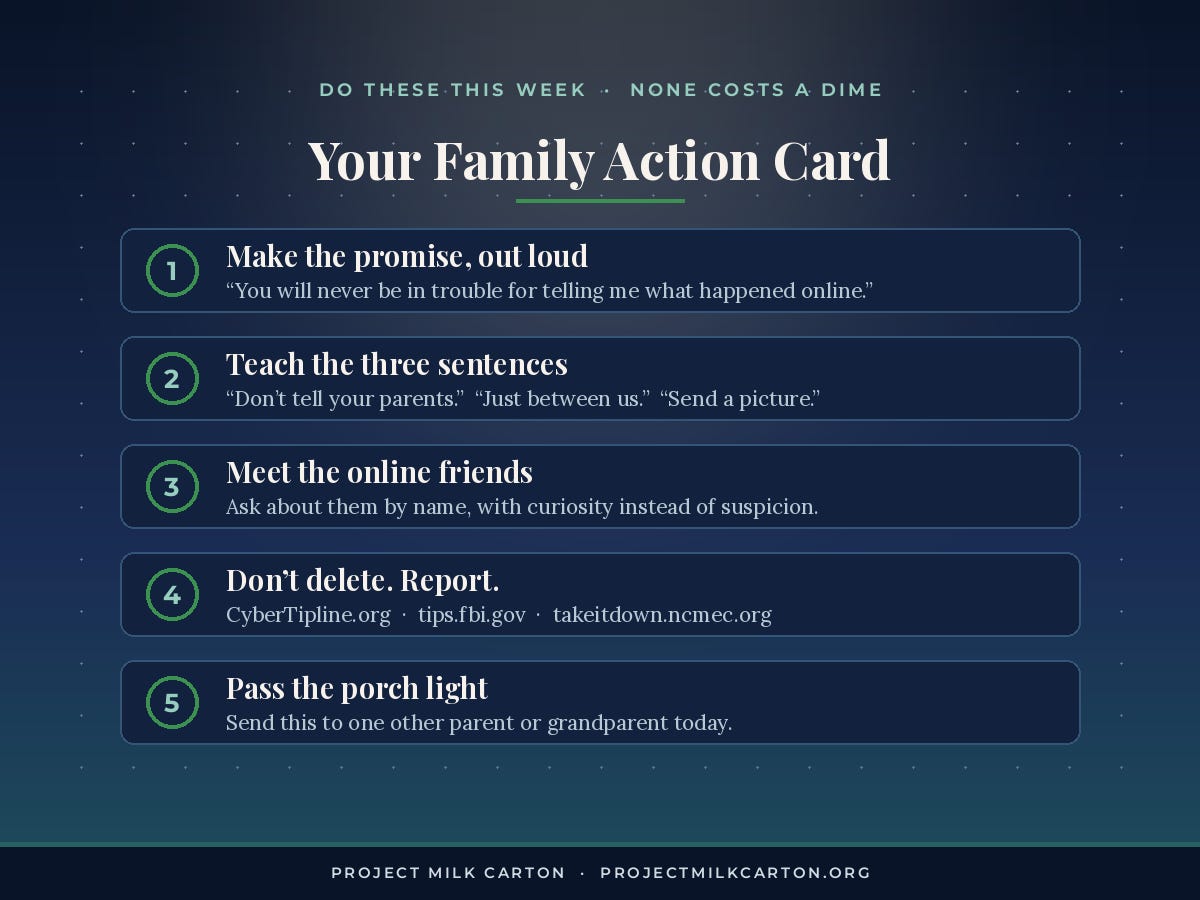
Teach the three sentences that mean someone has identified themselves, no matter how nice they’ve been: “Don’t tell your parents.” “This is just between us.” “Send me a picture and I’ll send one back.” Put them on the fridge.
Meet the online friends. You know the kids from school; ask about the ones from the game, by name, with curiosity instead of suspicion.
If your family finds something, don’t delete. Report. Save the messages. Report to the NCMEC CyberTipline at CyberTipline.org and the FBI at tips.fbi.gov or 1-800-CALL-FBI. If an image is out there, NCMEC’s free Take It Down service (takeitdown.ncmec.org) helps remove it. Then hold your child and tell them the truth: this was done to you, and you did the right thing by telling.
Pass the porch light. Send this article to one other parent or grandparent. That's how a network that depends on silence loses.
The couch can stay the couch. The giggling can stay the giggling. It just needs one more thing in the picture: a grown-up who knows.
projectmilkcarton.org • t.me/ProjectMilkCarton • X @P_MilkCarton
If you enjoyed this work and feel encouraged by transparency like this, please consider becoming a paid subscriber to Project Milk Carton here on Substack, or donate at Project Milk Carton Inc. or at https://t.co/PvtnrODkNz
Your support helps us turn information into action for children and families by:
keeping high-risk and missing children visible
identifying gaps in the systems responsible for protecting them
giving families and communities clear, usable information they can act on
supporting education, outreach, and practical community-based solutions
maintaining the public-data and open source work that makes this accountability possible
building tools and resources designed to help communities protect children before they disappear into a system
Most importantly, please share this article.
Transparency survives when ordinary people help spread information.
And informed communities protect children.
ALL paid subscriptions are 100% tax deductible
Project Milk Carton | 501(c)(3) | EIN: 33-1323547
Amazing work!
Thank you for reporting this problem and the severity of the issue.