

For a few years, the largest shelter for migrant children in America was a converted Walmart in Brownsville, Texas. Rows of beds where the aisles used to be. Nearly 1,500 boys under one big-box roof. Each of those children was there because an adult somewhere failed them, and each one was being cared for with money that came from you: your taxes, flowing through a federal agency, into a nonprofit organization most Americans had never heard of.
This is not an article about villains. It is an article about visibility. When our country hands a child to an organization, and hands that organization hundreds of millions of dollars, ordinary families deserve to see where the money goes. The good news is that you can. The public record on one such organization shows exactly why looking matters, and by the end of this piece you will know how to look at any of them yourself.
The story the public record tells
Southwest Key Programs, an Austin nonprofit, grew from five employees in 1987 into the nation’s largest provider of shelter for unaccompanied migrant children, collecting over $1.5 billion in federal contracts in a single decade according to the Texas Tribune.
In December 2018, the New York Times reported that the organization had stockpiled tens of millions of taxpayer dollars, lent millions to real estate developers, and rented shelter buildings partly owned by its own executives, and that federal officials had begun reviewing the possible misuse of federal money. Tax filings showed founder Juan Sanchez earned $1.5 million in 2017, roughly double the salary of the Red Cross chief, at an agency where the federal salary cap for grant-funded pay was supposed to be $187,000. His wife earned another half million. The chief financial officer resigned in February 2019; Sanchez resigned that March, saying the organization suffered from “widespread misunderstanding of our business and unfair criticism of our people.” Both executives, asked by the Times about owning stakes in properties the charity leased, said they would sell those interests.
The story did not end with new leadership. In July 2024, the Department of Justice filed a lawsuit alleging a pattern of sexual abuse and harassment of children in Southwest Key shelters going back to 2015, during years in which the organization amassed nearly $3 billion in federal contracts. Southwest Key strongly denied the abuse allegations. In March 2025, the federal government moved all children out of Southwest Key shelters and dropped the lawsuit, with no settlement or payment; the organization said it always believed the facts would prove the allegations to be without merit, and furloughed roughly 5,000 employees when placements stopped. At least two former employees had separately been convicted in state and federal courts of abusing children in the facilities. As of this writing, senators are still calling for oversight hearings into how children in contracted shelters are protected.
Every fact in those two paragraphs comes from court filings, tax records, and reporting you can click and read yourself. No secret sources. No theories. That is the point.
What this story teaches (and what it doesn’t)
It does not teach that nonprofits are corrupt, or that the people who work in shelters don’t love kids. The overwhelming majority do, often for modest pay and heavy hearts.
It teaches something more useful: when one organization holds both the children and the contracts, sunlight is not optional. A charity that depends almost entirely on government funding, pays its founder a fortune, and rents buildings from its own executives may have innocent explanations for every line item. Or it may not. Families are not required to guess, because the answers sit in public documents that anyone can open. The questions worth asking are simple ones. Who gets paid, and how much? Does the organization do business with its own insiders? Where does the money actually come from? You are allowed to ask all three about any charity in America, including ours.
Look for yourself: the afternoon skill
Every sizable nonprofit files a public tax return called a Form 990. Reading one is easier than reading a phone bill. Here is the whole skill:
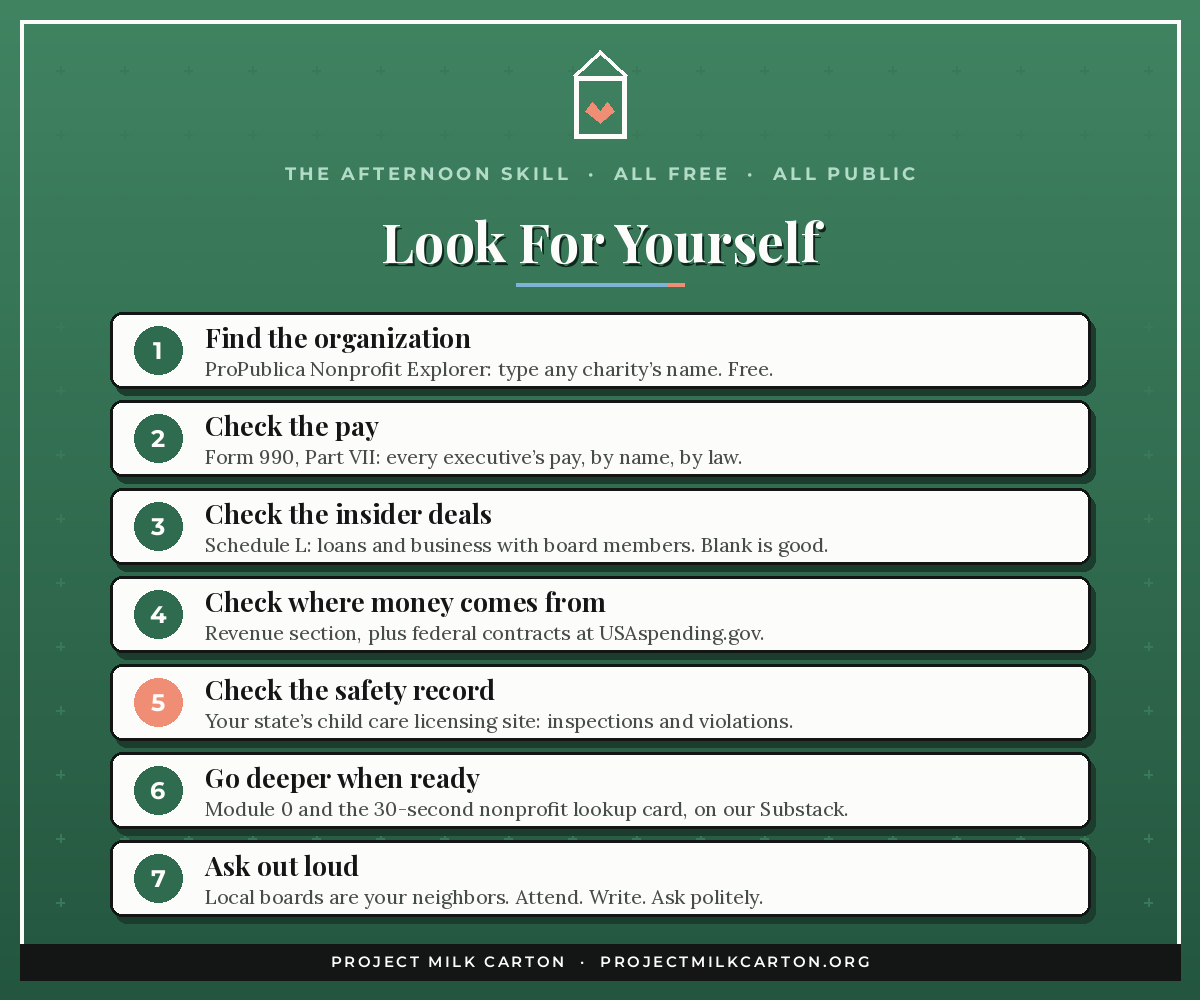
Find the organization. Go to ProPublica’s Nonprofit Explorer and type in any charity’s name. Free, no account needed. The IRS Tax Exempt Organization Search works too.
Check the pay. Open the newest 990 and find the section listing officers and key employees (Part VII). Every executive’s compensation is right there, by name, by law.
Check the insider deals. Look for Schedule L, “Transactions with Interested Persons.” This is where loans to insiders and business with board members must be disclosed. A blank Schedule L is a good sign. A full one deserves questions.
Check where the money comes from. The revenue section shows how much is government grants versus donations. You can also search any organization’s federal contracts at USAspending.gov.
Check the safety record, not just the money. Money records are federal. Safety records are kept by your state, and they are public too. Every state licenses the places where children live or spend the day, and most post their inspection reports online. Here is exactly how it works in Texas, click by click, so you can see how simple it is:
Type childcare.hhs.texas.gov into your browser. This is the state’s official Search Texas Child Care site, run by Texas Health and Human Services.
Type the facility’s name in the search box. Don’t know a name? Type just your city or zip code instead, and you will see every licensed operation near you. Click the yellow Search button.
In your results, find the facility and click More Details / Compliance History. This opens its Operation Details page.
Scroll down to the words “In the last three years, Licensing conducted the following.” Click the number next to reports.
On the next page, click All Deficiencies. Now you are reading the real record: each violation, the date it happened, how serious the state rated it, the deadline to fix it, and a written description of each incident.
Live in another state? Search the words “your state name, child care licensing search” and you will find your state’s version of the same website. Every state has one.
One more thing, and it matters most: records are for questions, but a child in danger is for the phone. If you ever believe a specific child is being hurt, call. In Texas, for example, the Abuse Hotline is 800-252-5400, answered 24 hours a day, and you can ask to remain anonymous. Every state has a hotline like it. Don't know yours? Call the national Childhelp hotline instead, 1-800-422-4453, day or night, and they will connect you to the right people for your state.
Go deeper when you’re ready. This afternoon skill is the front porch of a much bigger house. Our module series in The Founder’s Pen teaches the whole toolkit, starting with Module 0: The Game You Were Never Taught and the companion card How to Look Up Any Nonprofit in 30 Seconds.
Ask your questions out loud. If a charity operates in your town, its board members are your neighbors. Attend the meeting. Write the letter. Polite, specific questions from local families are one of the oldest forms of child protection there is.
And yes, please do this to us. Project Milk Carton’s EIN is at the bottom of every article we publish, and our filings live in the same public databases. An organization that teaches transparency should be easy to see through.
The heart of it
Do one thing before you close this tab. Think of one person you know who has ever said “I wish I could do something about what happens to kids.” Text or email them this article right now, with one sentence: “This shows you how to actually check on the places that get paid to care for kids.” That takes thirty seconds, and it hands someone a real tool instead of a worry.
projectmilkcarton.org • t.me/ProjectMilkCarton • X @P_MilkCarton
If you enjoyed this work and feel encouraged by transparency like this, please consider becoming a paid subscriber to Project Milk Carton here on Substack, or donate at Project Milk Carton Inc. or at https://t.co/PvtnrODkNz
Your support helps us turn information into action for children and families by:
keeping high-risk and missing children visible
identifying gaps in the systems responsible for protecting them
giving families and communities clear, usable information they can act on
supporting education, outreach, and practical community-based solutions
maintaining the public-data and open source work that makes this accountability possible
building tools and resources designed to help communities protect children before they disappear into a system
Most importantly, please share this article.
Transparency survives when ordinary people help spread information.
Informed communities protect children.
ALL paid subscriptions are 100% tax deductible
Project Milk Carton | 501(c)(3) | EIN: 33-1323547